.png)


You Don’t Spend Money. Your Past Does

I recently met my maternal uncle, along with his wife and elder son, at one of those small get-togethers, the kind where conversations start with food and somehow end with philosophy.
At some point, the discussion drifted to money. More specifically, ideas like “die with zero” versus succession planning. His view was simple: leaving behind too much money could dilute his children’s drive and ambition. Quoting Charlie Munger, I told him it might. But you still have to do it, because they may not forgive you if you don’t.
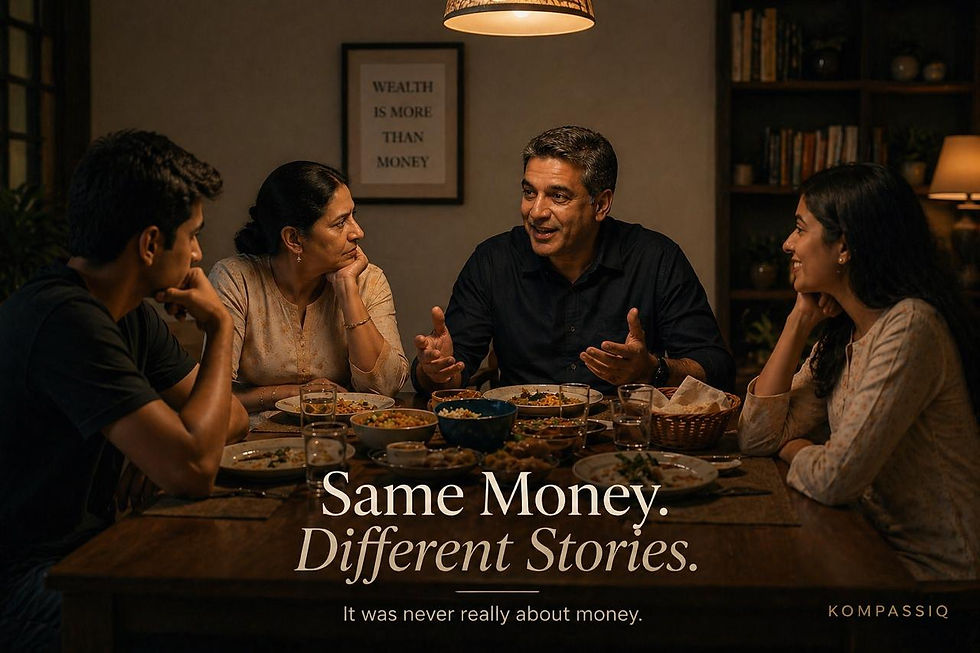
On paper, it sounded like an intellectual debate. In reality, it was far more personal.
My uncle, true to form, leaned toward enjoying money, using it and experiencing it. But the commentary around him had not changed. His wife and elder son still saw him as slightly irresponsible. Not in a dramatic way, just enough for it to become a recurring label.
Sitting there, I realised this wasn’t new to me. I had seen this dynamic play out for years. As a child, you don’t analyse these situations, you absorb them. Somewhere along the way, a quiet rule gets written: “Spending too much equals being irresponsible.”
That rule had an impact on me. It made me more cautious, maybe even slightly uncomfortable with spending.
Years later, you are earning your own money, and nothing looks obviously wrong. But something feels off. You hesitate before spending. You feel a pinch of guilt after. You save, but don’t always feel secure.
And then, somewhere else in the family, there is a nephew or niece watching a different version of the same story. An uncle being called miserly, too calculative.
Same topic, opposite labels.
And that’s when it hits you.
This was never really about money.
What is interesting is we make it personal. We say, “Maybe I’m just bad with money” or “I need more discipline.”
But most financial behaviour isn’t a discipline problem. It is a story problem, especially when the script was never written consciously.
At R&D Capital, we sometimes joke that we don’t just manage money, we manage money memories.
Two people with the same income, same goals, and the same opportunities can still make completely different decisions. Not because one is smarter, but because they have seen different things growing up.
And once you see that, something shifts.
You stop asking, “What’s wrong with me?” and start asking, “Where did this come from, and does it still make sense?” That’s a far more useful question.
It also helps you identify your “money hero.” Not necessarily someone you admire. Sometimes, it’s someone you are trying not to become. Most often, it’s a mix, someone who showed you what to do and what to avoid. Either way, they have shaped your instincts more than you realise.
The goal isn’t to overcorrect.
If you grew up around reckless spending, you don’t need to become extreme in saving. If you grew up around scarcity, you don’t need to deny yourself joy.
The goal is simpler.
To be a little more aware than yesterday.
Because once you are aware, you pause. And that pause is powerful. It’s where better decisions come from, not perfect ones, just slightly better ones repeated over time.
If any of this feels familiar, it might be worth asking:
What did I learn about money growing up? Which of those beliefs still serve me? Which ones am I just carrying out of habit?
You don’t need a complete overhaul.
Sometimes, a small shift in perspective does more than a big jump in income.
And if you ever want to explore this more deeply, not just the numbers but the thinking behind them, that is exactly the kind of conversation we like to have.
Quietly, thoughtfully, without pretending money is only about money.
Comments