.png)


Why Cash Flow Matters More Than Valuation in Investment Decisions

A business that bleeds slowly at ₹100 crore is still bleeding.
A founder-investor once said:
“The startup had a ₹50 crore valuation—but was burning ₹80 lakhs a month with no real customer retention. I passed.”
Another shared:
“I used to get excited by big valuation jumps. Now I ask one question: does the business generate or consume cash?”
This is the cash flow vs. valuation dilemma that trips up even experienced investors.
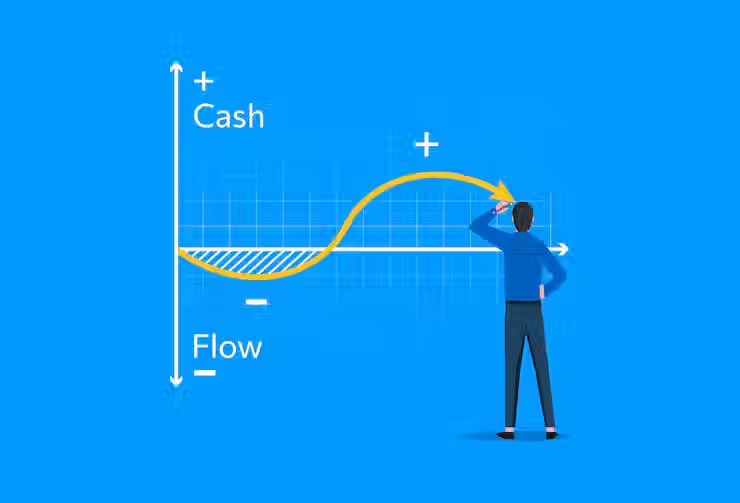
Valuation tells you what others think something is worth.
Cash flow tells you what it earns, sustains, or drains—every month.
Let’s unpack why cash flow is the real signal in any investment decision—and how to use it to separate story from sustainability.
Step 1: What Valuation Really Tells You
Valuation = what someone is willing to pay for ownership today.
It’s based on:
Future growth potential
Market buzz or funding dynamics
Multiples (revenue, EBITDA, etc.)
Comparative deals
But it doesn’t tell you:
How soon the business can stand on its own feet
Whether it needs constant funding to survive
If it has the margin and discipline to grow profitably
🧠 Valuation reflects expectations. Cash flow reflects execution.
Step 2: Why Cash Flow Is a Better Health Check
✅ Cash flow shows whether revenue is real and recurring
→ Are customers paying on time? Or is the revenue all credit + discounts?
✅ Cash flow tracks operational efficiency
→ How much of every ₹ earned is actually retained after expenses?
✅ Cash flow signals self-sufficiency
→ Can the business fund its own growth—or is it always fundraising to survive?
📌 Cash-generating businesses don’t just survive—they negotiate better, raise smarter, and grow leaner.
Step 3: How to Spot Red Flags Using Cash Flow
🚩 High revenue, but negative operating cash flow
→ Likely discount-heavy, poor collections, or inflated topline
🚩 “Profit on paper,” but net cash outflow
→ Could be capitalized expenses, aggressive accounting
🚩 Needs frequent top-ups (equity or debt) to stay afloat
→ Fragile unit economics, no path to sustainability
🧠 A business that shows positive cash from operations is fundamentally stronger than one showing inflated valuation on pitch decks.
Step 4: When Valuation Can Be Misleading
High valuation in early rounds ≠ real value if follow-on funding dries up
Rapid valuation jumps can outpace actual financial health, leading to unrealistic investor expectations
Buying in at inflated valuation means less upside, more pressure to find a “greater fool”
For SMB investors and founders, a ₹10 crore cash-generating business can be safer than a ₹100 crore loss-making one.
Step 5: Cash Flow as a Strategic Filter
Before investing—ask:
Is there a clear cash conversion cycle?
Are customers paying faster than the company pays vendors?
How long can the business survive without external capital?
Has revenue grown alongside improved operating margins and working capital cycles?
If the answer is "no" or "unclear," pause.
💡 Your capital should fund growth, not survival.
TL;DR – Too Long; Didn’t Read
Valuation reflects expectations; cash flow reflects financial reality.
A high-valuation company can still be cash-negative and unsustainable.
Positive cash flow means better pricing power, customer retention, and capital discipline.
Always check operating cash flow—not just topline or funding rounds.
Invest in businesses that create cash—not consume it endlessly.
A flashy valuation may impress a boardroom.
But only cash flow buys time, freedom, and peace of mind.
Because the smartest investment isn’t the loudest.
It’s the one that earns while everyone else is pitching.
Comments